Sunday, October 26, 2008

PRIDE AND GLORY

Review: Pride and Glory
3 stars (out of 5)
By R. Kurt Osenlund

Police dramas are a dime a dozen. Whether scrolling through the channel guide or standing in the ticket line, for every award-worthy “Shield” and “Departed,” there's a horde of second-rate “Cold Case”s and “Righteous Kill”s. “Pride and Glory,” an occasionally gripping but overly complicated potboiler about a corrupt pack of New York's finest, ranks somewhere in the middle of this crowded hierarchy, leaning precariously toward the lesser end of it. It's a good thing director and co-writer Gavin O'Connor called in reinforcements.

The movie stars gritty-cop-film-school valedictorians Edward Norton and Colin Farrell as brothers-in-law Ray Tierney and Jimmy Egan, two boys in blue who operate on different ends of the moral spectrum. Ray, living off the grid on a docked boat after an ambiguous tragedy left a scar on his face and his reputation, takes after his father, Chief of Manhattan Detectives Francis Tierney, Sr. (Jon Voight), and swears by the code. Jimmy, living off lousy wages and making up for it with shady deals, serves under Ray's brother, Francis Tierney, Jr. (Noah Emmerich), and hovers above the law. The world of this badge-wielding brood is thrown into an upheaval when four of their fellow officers are slain in a drug bust gone awry. Lured out of hiding and put on the case, Ray smells an in-house rat and all signs point to Jimmy (and, perhaps, Francis, Jr.). In what snowballs into one seriously messy game of good cop/bad cop, Ray must ultimately choose between family ties and professional responsibilities (if only the title, “Justice and Loyalty,” sounded as cool). This is a pedestrian plot that's pretty cut-and-dry once it loops around itself. Getting to that point, though, is quite a bumpy ride.


I certainly don't need – or want – things spelled out for me but “Pride and Glory” had me scrambling for a user's manual. Needlessly gnarled and arbitrary in structure, it breaks its own back with strained attempts at cleverness. Without warning or viewer regard, it throws around names after barely introducing them, builds up urgent scenes then casually breezes through them, hints at dark pasts but takes forever to clarify them – and dares you to keep up. (It wasn't until about halfway through that I realized one main character's sister is another main character's wife.) Watching this movie is like being the stranger at a cliquey social event; everyone's in on the good dish but you. Soon enough, it becomes less an intriguing mystery to solve and more a laborious task to sit through.

To the rescue is a strong-as-steel cast led by Norton, an actor who seems forever cursed to bear the weight of the world on his shoulders. Film after film, role after role, Norton continuously plays characters who are stricken with demons, regrets, or, at the very least, deep thoughts. That niche of emotional and mental baggage is what the thinking-viewer's-favorite plays well; watching him, you can almost hear the gears grinding behind that stern, troubled face. Farrell, who nailed a Norton-type part earlier this year in Martin McDonagh's masterstroke, “In Bruges,” does a complete 180 as Jimmy, a remorseless, money-hungry villain. The notoriously reckless Irishman plays Jimmy scarily well, perhaps tapping into the bad boy that he's finally managed to curb in real life. Farrell does things here that you've never seen him – or, quite possibly, anyone – do on screen before, and the alarm of such heated moments temporarily revives the film.


“Pride and Glory” has bursts of intensity that grab you by the throat. If O'Connor (“Miracle”) and his writing partner, Joe Carnahan (the very similar, “Narc”), had dispersed that energy more evenly, clearly, and carefully, they could have generated a distinctly strong cop picture. Instead, they try to toughen up their material in two-bit ways, such as giving their actors lines that are overflowing with expletives. This movie has enough f-bombs in its first 15 minutes for an entire episode of “The Sopranos,” maybe two (and that's saying a lot). I'm sure O'Connor, who was raised by a New York cop and “grew up in that world,” would argue that this is the way these men really talk. Maybe so, but I believe “NYPD Blue” – arguably the preeminent dramatic depiction of the modern New York police force – made it through 12 seasons without a single utterance of the four-letter-word. Profanity for emphasis of feeling is good. Here, it's used to an extent that's gratuitous and distracting, not to mention silly.

I read a review of “W.” last week in which a critic predicted that Oliver Stone's Bush biopic would be “forgotten in a flash.” I disagree. “Pride and Glory” is much more the type of flick with a one-way ticket to oblivion, forever to be lost in a sea of like-minded fare. Its premium talent (Voight and Emmerich also impress, considerably) and few hard-hitting scenes place it well above some of its brethren, but it's still a movie that's barely worth watching, let alone remembering.

Sunday, October 19, 2008

W.

Review: W.
3.5 stars
(out of 5)
By R. Kurt Osenlund

The best thing to be said about the Bush biopic, “W.,” is that it's a sign of a return to form for director Oliver Stone. One of the real original mavericks, Stone was crafting smart, hot-button political dramas (“Born on the Fourth of July,” “JFK,” “Nixon”) long before he was applying cheesy Hollywood conventions to historic tragedies (“World Trade Center”) and everything but the kitchen sink to sagas about historic conquerors (“Alexander”). With its omnipresent bounciness and decidedly fair depiction(s), “W.” nibbles when it should bite, but its tremendous ability to both fascinate and entertain graciously suggests that, somewhere in there, Stone still has the chops and the nerve to make great movies.

“W.” is not a great movie but it comes pretty close. As absorbing as any political thriller, there's hardly a single dull moment in its 131 minute span. The script (by Stone's “Wall Street” scribe Stanley Weiser) uses criss-crossing chronology to illustrate Bush's rise to power. Jumping back and forth from the uncertain time between 9/11 and the Iraq War to the booze-soaked formative years in Texas, it offers executive decisions alongside frat boy pranks. Along the way, we also take in backyard barbecues, odd jobs, domestic disputes, car accidents, father-son fights, AA meetings, campaigns, debates, speeches, and prayers, all leading up to our president's eventual fall from grace. The film reads like a rock star's legacy played out on Capitol Hill and it's Stone's best work in years. What's surprising – and a bit disappointing – about the director's approach is how much he's chosen to file down his teeth. While far from being bi-partisan, “W.” isn't nearly as left-leaning or jabbing as one would expect, especially from someone as famously controversial as Stone. Instead, it paints Bush as a rather tragic sad clown, full of frailty and daddy issues. The aw-shucks courtesy of such a sympathetic take is dignified but it clashes with the movie's intrigue.


From a technical standpoint, Stone deserves nothing less than applause. Title notwithstanding, the director sees to it that we remember precisely who this film is about at all times. Often in close-up or extreme close-up, he keeps his camera fixed on Bush, regardless if he's running his 3-mile morning jog or running for Congress. Sometimes from low, imperial angles, we see this troubled man of power succeed, suffer, and sweat. Never one to skimp on aesthetics, Stone knows the weight of his material and finds a look to match it.

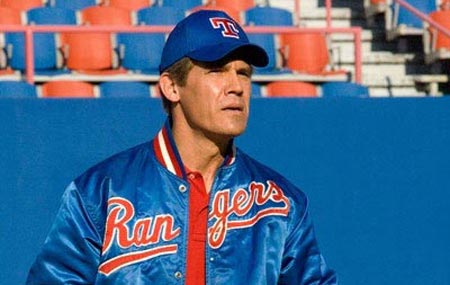
As the big man himself, Josh Brolin touches brilliance. He's on dangerous ground, playing someone who's been parodied to death, but he thankfully sidesteps “Saturday Night Live”-style sketch comedy by finding the perfect balance of caricature and honest portrayal. The magnetism of the subject matter lends a mighty hand, but Brolin deserves much of the credit for convincing us that what we're watching is more than just a movie. His performance is brave, immersive, and well-rounded and it's one of the best of the year. Fittingly, Brolin has a massive amount of support, chiefly from Elizabeth Banks, who glows in her biggest role yet as Laura Bush. Not far behind are Toby Jones as Karl Rove, Richard Dreyfuss as Dick Cheney, Jeffrey Wright as Colin Powell, and James Cromwell as Bush Sr., all of whom dig deep into their real-life counterparts in equally human and humorous ways. The sole cartoonish player in this game is Thandie Newton as Condoleeza Rice. Exaggerating the Secretary of State's twitches and grimaces to the umteenth degree, Newton's amateurish imitation is “W.”'s only forced joke.


The rest of the film's comedy (and horror) seems to manifest simply from our acute awareness of its source. Nothing that's “revealed” to us about Dubya's private life holds a candle to what he's done publicly, which Stone recreates in seamless 35 mm and mock archival footage. In an all-too-memorable press conference, when Bush is asked by a reporter to reveal his biggest presidential regret, his stuttering admittance to having “confidently made mistakes” is as painfully funny as ever. During speeches, the oblivious use of words like “nucular” has a priceless ring that no screenplay could top. In other words, you just can't write this stuff. Like Michael Moore's “Fahrenheit 9/11,” Stone's film proves once and for all that, no matter what directorial stance is taken or what editorial techniques are employed, a character as naturally buffoonish as Bush can do bad all by himself.

The worst thing to be said here is that “W.” could be terribly ill-timed. Amidst this crazy election, which is arguably just as entertaining, is anyone even thinking about Bush? Does anyone even care? As unprecedented as Stone's push for a 2008 release may be (find me another film that's directly devoted to skewering a sitting president), the director faces a very real danger of the public's fatigue of the current Commander in Chief winning out over its curiosity. Undeniably important in spite of it weaknesses, “W.” seems primed to have the lasting power of Stone's better projects. More immediate success will be determined by whether or not today's moviegoers have any interest at all in approving this message.

Saturday, October 11, 2008

HAPPY-GO-LUCKY

Review: Happy-Go-Lucky
4 stars (out of 5)
By R. Kurt Osenlund

There's a fleeting moment in “Happy-Go-Lucky,” the aptly-titled and altogether delightful new film from Mike Leigh (“Secrets & Lies,” “Vera Drake”), when sprightly heroine Poppy (Sally Hawkins) gazes out the window of her North London flat and comments on how beautiful the sky looks. Cut to what she sees: a grayish-blue horizon covered with big, puffy clouds. It's hardly a remarkable sight and, in fact, rather ordinary; just another day in the UK. But Poppy is someone who finds splendor and joy in just about everything. She's blissfully content in her modest little life and this film is essentially a spirited frolic through a slice of it.

Poppy is 30 years old, single, and a teacher at an elementary school. She lives with Zoe (Alexis Zegerman), her best friend from college who teaches in the classroom next door. Poppy's dress matches her demeanor; she's literally colorful from head to toe, like Cyndi Lauper outfitted by Patricia Field. On weekends, she hits the clubs with Zoe and the gals and drinks and dances the night away. She's open-minded, unbiased, and greets everything and everyone with a smile. When we first meet her, she's just had her bicycle stolen, and her reaction is: “I didn't even get to say goodbye. Oh well.” The movie explores the ways in which the people whom Poppy encounters react to her impossibly upbeat attitude. Those who have a similar approach to life, like Zoe, adore her company. Those who accept but don't quite understand her, like school principal Heather (Sylvestra Le Touzel), see her behavior as childlike and nonsensical. And those who take life way too seriously, like Poppy's pregnant an unhappily married sister, Helen (Caroline Martin), find her downright threatening.


It's understandable why some folks would run in the other direction if they saw Poppy coming down the street. Imposing her glee upon others – “Stay happy!” she says, often – she's the kind of person most world-weary adults find exasperating. Her biggest challenge comes in the form of Scott (Eddie Marsan), a somber driving instructor she hires soon after she's rendered bike-less. A repressed loner who's unhealthily consumed by his existence-defining job, Scott is Poppy's polar opposite. Their exchanges, which take place during lessons every Saturday for weeks, create an interesting dichotomy and the story's central conflict. Poppy is faced with other challenges (a bully at school, a back injury, a new romance, a moody instructor at her and Heather's Flamenco dance class) but none so daunting as Scott. The two repeatedly test each other's patience, sometimes humorously, sometimes coarsely, and their relationship eventually reaches a climax that's a powerhouse for both actors, especially Marsan.

As is the case with most of Leigh's films, the performances in “Happy-Go-Lucky” are sublime. Hawkins, who was previously seen in “Vera Drake” and John Curran's “The Painted Veil,” won the Silver Bear at this year's Berlin Film Festival for her role as Poppy and may just ride that momentum all the way to Oscar. In what will surely be remembered as her breakthrough, she's a natural, bringing to life a character who's blithe and bubbly but devoted where it counts. Zegerman, who makes her film debut, is just as lovable as Zoe, a tough yet silently sensitive sidekick who we're glad to know is in Poppy's corner.


Leigh's script deserves equal praise. Bright, honest, and lightning-paced, its dialogue surpasses the oft-overworked zingers in “Juno,” many of which seemed too hipster even for angsty Ellen Page. Clearly aided by unbridled actor improv, the conversations truck along with a rapid and believable familiarity among the characters. Even though we aren't immediately aware of the nature of Poppy and Zoe's friendship, the film entrusts that we'll stick around to find out, and we trust it right back. Its words are often light but not superficial, airy but not air-headed, and, when necessary, reach for profundity. During one of their lessons, Scott, infuriated with Poppy, insists that she “act like an adult.” Poppy, looking at the strange and miserable “grown-up” next to her, replies, “What, like you?”

Which brings me back to the view from the window. It's one of the few scenes in which we're given the opportunity to see the world directly from Poppy's eternally optimistic perspective. Am I wrong in calling her vista “ordinary” and “unremarkable?” Do her disappointment-resistant eyes see something mine don't? Am I just another cynic who sees the sky as half gray instead of half blue? Perhaps. With “Happy-Go-Lucky,” Leigh's message is clear: if one is to attain true happiness in life, carefree is the best policy. That may seem like a difficult task in these difficult times but Poppy sure does make it look easy. The film leaves us with some unresolved plot elements (and I'm risking mild spoilers here): we never learn whether or not Poppy finally gets her driver's license, nor do we find out if her Flamenco classes amount to more than just an after-school activity. The outcomes matter little to us and even less, I'd imagine, to Poppy.

Friday, October 3, 2008

APPALOOSA

Review: Appaloosa
3.5 stars (out of 5)
By R. Kurt Osenlund

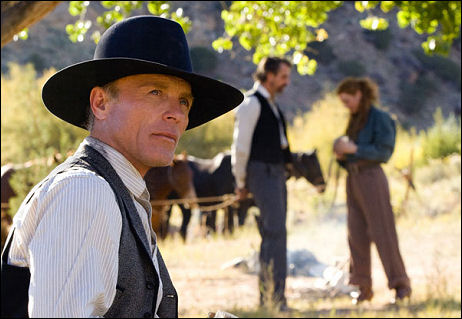
In an interview promoting “Appaloosa,” Ed Harris, the film's director, co-writer, and lead star, observed the near-death of the Western in modern cinema, saying he could count the recent successful examples “on one hand – or maybe half a hand.” Thanks to his own efforts, Harris can now proudly extend another finger. His classic, no-frills picture, an adaptation of Robert Parker's 2005 buddy-cop-on-the-range novel, is a fine addition to the endangered genre. However, if you're looking for shoot 'em up thrills, you're drinking at the wrong saloon. This intimate character study is more “Brokeback Mountain” than “Rio Bravo.”


Don't get it twisted, brohams – this is no gay affair, but its primary focus and flowing undercurrent is the relationship between two gunslinging cowboys (played with top-notch chemistry by Harris and Viggo Mortensen), nestled in a story with hardly any gunslinging at all. When marshall-for-hire Virgil Cole (Harris) and his right-hand deputy, Everett Hitch (Mortensen), roll into Appaloosa, a one-horse town in 1882 New Mexico, they certainly come armed for battle. Hired by the town's politicians to restore order in the shadow of formidable outlaw Randall Bragg (Jeremy Irons) and his pack of goons, Cole and Hitch act quickly, killing some peace disturbers right off the bat and laying down their own form of martial law. After that, they quiet down, and so does the film, shifting its attention to the dynamics of the duo's playful, personal bond. The threat of Bragg still looms, and the occasional standoff ensues, but “Appaloosa” draws its fire from less obvious sources.

Cole and Hitch's alliance is tested – as is our patience – with the arrival of Allison French, an increasingly toxic tramp-in-distress played by the increasingly horrific Renee Zellweger. I don't know what's become of the natural, spunky girl-next-door from “Jerry Maguire,” but she's never been more far away or missed than here, an abysmal low point in the actress' career. Squinty-eyed, rosacea-cheeked, and perpetually pucker-faced, Zellweger doesn't just make French appropriately detestable, she mucks up Harris' otherwise strong show. As mentioned, Harris and Mortensen have a killer rapport – it's lived-in, it's funny, and it's delicately underplayed. Harris gives Cole a coiled-up, authoritative coolness and Mortensen matches it with a knowing aplomb. The only good thing that can be said about Zellweger is that she is one with her character. French is the wedge threatening to divide the film's core companionship – she latches onto both men, especially Cole – and Zellweger is the virus threatening to infect the film itself. Thankfully, her presence is only mildly malignant.


For all its narrative subtleties, “Appaloosa” soldiers ahead with surprisingly brute force. Save Cole, who notes the length of he and Hitch's partnership and reveals a sordid past of trysts with hookers, nary a single character is given any back story. From the first frame, the film dives right into the story at hand. That the story lacks many bullets may bore certain viewers, but I found the minimalistic approach quite interesting. Harris, whose only other directorial credit is 2000's Oscar-nominated biopic, “Pollock,” uses that same approach in designing his sophomore effort. His take on the Western is restrained and traditional. Clearly an admirer of the work of John Ford and Sergio Leone, he gives us all the trappings of the genre, usually in carefully framed shots: wide open desert spaces, big blue skies, winding railroads overseen by chop-licking mountain lions, a town that looks like it's right out of a 1950s back lot, and even scalp-hunting American Indians. (I kept waiting for a tumbleweed to blow by.) Die-hard Western fans will revel in Harris' adherence to this style.

During my screening, a woman behind me observed that Harris' craggy, square-jawed face “looks like the mountains.” She was right. Looking at the focused four-time Oscar nominee, in the wake of Paul Newman's death, it's clear that he's in the top tier of our cherished, seasoned leading men. He finds a kindred spirit in Mortensen, a slightly younger star with a similar countenance, whom he previously worked with in 2005's “A History of Violence” (which reportedly planted the seed for this new collaboration). If they'd been working in the era when Westerns were all the rage, we could easily imagine this pair starring side-by-side in a slew of them. Their strong visual and visceral match-up is crippled only by Zellweger, whose awkward mug weighs down a movie that's notable for, but deeper than, its face values.

Friday, September 26, 2008

MIRACLE AT ST. ANNA

Review: Miracle at St. Anna
2.5 stars (out of 5)
By R. Kurt Osenlund

“Miracle at St. Anna,” about (at its buried core) a group of wrongly forgotten black American soldiers trapped in Tuscany, Italy during WWII, feels like a story that needs to be told. Spike Lee, ever the brilliant puppeteer of probing controversies and racial tensions, seems like the right person to tell it. A funny thing must have happened on the way to the set because this convoluted genre milkshake – a pseudo-satirical religious fantasy swirled up inside a grisly war epic – is, dizzyingly, just about everything but a comfortable fit.

Working from a script by James McBride (who adapted his novel of the same name), Lee gives us a strange cluster of many different films, all crammed into one. We begin in Harlem in 1983, where an aged postal worker has just inexplicably shot a man with a German Luger in broad daylight. When the cops search the perp.'s apartment, they find out he's a decorated war veteran and also discover the head of a 450-year-old Italian statue in his closet. A rookie reporter (Joseph Gordon-Levitt) gets access to the man's prison cell and starts questioning him in an attempt to connect the dots. So, it's a mystery/thriller? Not really.


We flash back to 1944, where members of the US Army's 92nd Buffalo Soldier Division trudge through a swampy battlefield in Italy. They exchange familiar jokes. They're taunted, via radio, by the voice of a cunning German woman who tells them of America's disdain for blacks and offers them fried chicken and grits in exchange for their surrender. Suddenly, bullets and missiles start flying, people start dying, and there are numerous gratuitous shots of detached limbs and bloody bodies. So, it's an intentionally funny B-picture? Not so fast.

Four of the soldiers end up behind enemy lines. There's Staff Sgt. Aubrey Stamps (Derek Luke), Sgt. Bishop Cummings (Michael Ealy – who gives the film's best performance), Cpl. Hector Negron (Laz Alonso), and Pvt. Sam Train (Omar Benson Miller), who carries the statue head from the beginning in a sack on his hip and rubs it for luck. The crew holes up in a rebel village, but not before rescuing an orphaned, 8-year-old child named Angelo (Matteo Sciabordi) who bonds with Train and, apparently, has magical powers ordained by God. There's also a group of Italian freedom fighters, a pack of Germans who are introduced like James Bond villains (thanks to Terence Blanchard's ludicrous score), and enough eventual bloodshed to paint the whole town red. So, it's a war movie after all? Not exactly.

Throughout his career, Lee has shown an uncanny ability to make his viewers profoundly uncomfortable, causing them to confront and reflect upon issues they may not often think about. (I can vividly remember my first screening of his 2000 satire, “Bamboozled,” in film school: me, a somewhat ignorant white kid in a room full of mostly black students, on the verge of tears after the film's climactic barrage of potent images.) Here, the discomfort created is not provocative but utterly perplexing. The story is surprisingly easy to follow, and Lee ties up its many loose ends, but the multiple tonal shifts overshadow any shot at clarity. After most scenes, it's hard to know whether to laugh, cry, or even care about what just happened.


I counted only three instances in which I took this film seriously and, through which, I saw the Spike Lee I know shine. The first is a flashback within the flashback (there are a few of those), when the group recalls an incident at a Louisiana diner that caused them to defend themselves against prejudice. The second is a simultaneous prayer sequence voiced by three separate parties that employs Lee's trademark direct address. The third is the infamous massacre at Sant'Anna di Stazzema (the place of the title), which Lee unabashedly depicts in devastating detail, right down to the last slaughtered child.

It's in such affecting moments that the director's admirable intention of unearthing lost truths comes to light. Too bad his execution pulls us in so many directions that, by the end, we feel like rubber. “St. Anna” is constructed with such a dumbfounding, scatter-brained inconsistency that, had it been directed by a first-time filmmaker, I'd be tempted to label that person as either a genius or a psycho. Well, I've seen enough of Lee's work to know that he's close to genius – the man also teaches film at NYU and Columbia – but too much of his latest project borders on crazy. The only miracle is that I got through the whole thing with my sanity intact.

Friday, September 19, 2008

GHOST TOWN

Review: Ghost Town
3 stars (out of 5)
By R. Kurt Osenlund

By the end of “Ghost Town,” the new spectral comedy from screenwriter-turned-director David Koepp (“Secret Window”), I was stuck on the fence. Here is a movie that is markedly mediocre, highly predictable, and almost instantly forgettable. At the same time, it boasts a very funny lead performance and a surprisingly heartwarming third act, leaving my opinions in limbo. My hope is that, by the end of this review, I'll have crossed over to one side or the other.

If Ebeneezer Scrooge had a great-great-grandson who moved across the pond to Manhattan, he'd probably be something like Bertram Pincus, an antisocial dentist who hates everyone and chose his profession, mainly, because he can shut people up with cotton and Novocaine whenever they get too chatty. On his day off, Bertram undergoes a colonoscopy (the easy explanation for which is potty-joke potential) and, after an adverse reaction to anesthesia, is declared dead – for seven minutes. When he wakes up, he realizes he's been gifted with a sixth sense: he can see (and hear) dead people. But for someone like Bertram, who avoids strangers on the street like thorn bushes, this is no gift at all. His worst nightmare has come true: the needy souls of deceased New Yorkers, from construction workers, to cops, to little old ladies, have gotten wind of his ability and won't leave him alone. One of them is Frank Herlihy, a fast-talking opportunist who's killed off in the first scene by a speeding bus. Frank tells Bertram that he'll back off (and, somehow, get the others to as well) if Bertram agrees to help foil the forthcoming marriage of Frank's widow, Gwen, a curator of sorts, working at the Metropolitan Museum of Art.


Bertram is played by brash Brit Ricky Gervais, the Emmy and Golden Globe-winning star of the UK version of the TV series “The Office,” and the movie is definitely his star vehicle. Gervais is excellent here, delivering every line and insult with that acerbic, English-style matter-of-factness. That he was cast in the role does wonders for the film. Frank is played by Greg Kinnear, a fine actor who's made indispensable contributions to dramedies like “As Good as it Gets” (for which he received an Oscar nomination) and “Little Miss Sunshine.” In “Ghost Town,” he doesn't do much to put a stamp on his character, and we can easily envision many other actors filling Frank's shifty shoes. Gwen is played by Tea Leoni, a gifted and underrated actress whose natural beauty, stern focus, and contralto-like voice usually combine to create intelligent, emotionally complex characters (see: “Deep Impact” and “The Family Man”). She displays those same qualities here, giving Gwen, who still can't quite let go of Frank after 14 months, just the right balance of fragility and strength.

As a writer, Koepp has penned his fair share of thrills and spooks for directors like Steven Spielberg (“Jurassic Park,” “War of the Worlds”) and David Fincher (“Panic Room”). As director and writer, he crafted another film about a man who sees ghosts, the 1999 shocker “Stir of Echoes.” “Ghost Town” marks Koepp's first foray into supernatural comedy since 1992 when he scripted the eternal youth-gone-awry giggler, “Death Becomes Her,” for Robert Zemeckis. The gap seems to have left him a little dry for fresh ideas. His new offering unfolds like a Top 40 pop song: familiar hook, familiar lyrics, familiar beat (it has annoying, repetitive elements, too, like characters who insist on interrupting one another -- a joke that's meant to inspire laughs but, from me, elicited groans). The film is built like a catchy tune, but don't expect it to stick in your head.


Any moviegoer worth his or her salt can anticipate the turns of this plot. As one would expect, Bertram (somewhat) fulfills Frank's request and then regrets it. As one would expect, Bertram and Gwen entertain a romance that could only occur in the movies. As one would expect, Gwen finds out that there's more to Bertram's story, resulting in the inevitable, all-is-lost betrayal scene. As one would expect, Bertram's journey through the film helps him to rejoin the human race, thanks (in large part) to those who are no longer a part of it. Just like Scrooge, he's a hopeless grump until some insightful spirits show him the error of his ways. And then, the unexpected happens: the film takes a big tug on your heartstrings and doesn't let go. Once Bertram sees those errors and commits to fixing them, “Ghost Town” goes tender, with at least one tear-jerking surprise, and ends its last verse on a warm high note.

You can see my dilemma. And where do I stand now that all is said and done? Ultimately, I'd feel guilty advising readers against this ultimately – for lack of a better word – 'nice' movie. And it does have moments of true hilarity, specifically when the other actors seem genuinely entertained by the sporadic improv of Gervais, a genuine comedic talent. So, go ahead, have a night out on the “Ghost Town” (sorry, I couldn't resist), just be fully aware of the film's certain afterlife: the DVD clearance rack.

Sunday, September 14, 2008

BURN AFTER READING

Review: Burn After Reading
4 stars (out of 5)
By R. Kurt Osenlund

The Coen Brothers are a curious pair. As a filmmaking team (with Joel often directing, Ethan producing, and both of them dreaming up their inventive scripts), their combined sense of humor is some the driest in the business and, lately, their movies tend to be highly nihilistic in tone. And yet, with their superior storytelling and technical skills, they repeatedly manage to tap directly into whichever viewer emotions befit their current project. Last year, the Coens took home Best Picture, Best Director and Best Adapted Screenplay Oscars for the inhumane but indelible “No Country for Old Men,” a thriller that hits you like a punch to the gut. And how do they follow that up? By rallying a selection of Hollywood's finest to play out their random and raucous spy comedy, “Burn After Reading.” Whereas “No Country” had no resolution, “Burn” has no purpose – except to make you crack up through most of its 96 minutes.


Where to begin with describing this film? The plot meanders down such zany roads that even two characters have to periodically clarify it for one another, resulting in some of the movie's funniest scenes (but, more on that later). First, we've got Osbourne Cox (John Malkovich), an embittered and unhinged “alcoholic” who recently quit his job with the CIA after an unjust demotion. Osbourne's wife, Katie (Tilda Swinton), a tightly-wound career woman, is sleeping with Harry Pfarrer (George Clooney), a federal marshal who's also married and has a few other “activities” on the side. Then there's Linda Litske (Frances McDormand) a wifty serial dater who's seeking to transform herself via numerous cosmetic surgeries that she can't afford. Linda works at the D.C. gym Hardbodies with Chad Feldheimer (Brad Pitt), a blissfully ignorant trainer who's too busy pounding away on treadmills and jamming to his iPod to care about properly forming a sentence. A CD-ROM containing Osbourne's memoirs lands in the inept hands of Linda and Chad, who hold it for ransom when they think it's encoded with government secrets and will stop at nothing to get paid.

“Burn” harks back to another dark Coen comedy, the 10-year-old cult hit, “The Big Lebowski.” In that film, slacking stoner Jeffrey Lebowski (Jeff Bridges) gets in way over his head when he stubbornly seeks undeserved compensation from people way out of his league. The same scenario unfolds here. Linda, sweet and well-meaning as she may be, thinks she's entitled to her elective procedures and sees Osbourne's so-called “information” as her free ticket to beauty. With the help of go-getter Brad (who's too dumb to know the difference between right and wrong), she sparks a hilariously unnecessary chain of events that affects every character and reaches as high as the CIA and the Russian embassy. Normal people can sense when they've crossed the line with their selfishness, but for those like Lebowski and Linda, personal interest seems to trump all logic. Nearly everyone else in “Burn” is just as foolish and all of them are just as egocentric, a combination that usually leads to big, big laughs.


Now, let's talk about this killer cast, sure to be one of 2008's strongest. As Osbourne, Malkovich is hysterically volatile, ready to spout a curse or swing a weapon without a hint of forethought. McDormand goes places we've never seen her go before, ditching her usual, witty quirkiness for a ditzy blonde and overacting to comic perfection. Clooney gets the tone of the material just right, conveying an intermittent shock and surprise that's equally felt by the audience. Pitt hasn't had this much fun on camera in years, playing his highlighted and high-spirited character like a cross between Ryan Seacrest and Jake Steinfeld. And Swinton, as the cold-as-ice Katie, dusts off her witch from 'The Chronicles of Narnia” and chews through her scenes (she's also gifted the film's most ironic revelation, of which there are many). The principal performances are dead-on, all of them fearless and uproarious, but the supporting players are the unsung heroes of this picture. As Katie's gold-digging divorce lawyer, J.R. Horne (The Coens' “O Brother, Where Art Thou?”) had me rolling. As Hardbodies' pushover of a manager, the great Richard Jenkins (“The Visitor”) pulls off pathetic and sympathetic simultaneously. And as two CIA superiors who must decipher and clean up this story's mess, David Rasche (TV's “All My Children”) and J.K. Simmons (“Juno”) are a deadpan dream team.

For all its haphazardness, this needlessly paranoid paranoid thriller (even Carter Burwell's score creates nonexistent suspense) is surprisingly succinct. We literally drop in on this crazy caper, then just as soon pull right back out. “Burn” does feel like an in-between, pet project for the Coens; however, it's still better than what many directors serve up as their main course. Besides, it's completely aware of itself as throwaway fare, featuring an in-text disclaimer that practically renders it critic-proof. Not that many critics would disagree: “Burn After Reading” is one of the funniest films of the year.